Two years ago, I started a list off all the books I was reading, wanted to read, and wanted to re-read. Since the I have read over 140 books and 40,000+ pages.
Here are some of the best and worst...
Best re-reads:
8. King of the Wind (M. Henry)
7. Roses for Mama (J. Oke)
6.They Called Her Mrs. Doc (J. Oke)
5. Little women Series~ Little Women, Little Men, Jo's Boy's (L. M. Alcott)
4. the Valley of Fear (A. C. Doyle)
3. Pearl Maiden (H. Rider Haggard)
2. Carry On Mr. Bowditch (J. Latham)
1. Wives and Daughters (Elizabeth Gaskell)
Worst re-read:
Too Long a Stranger (J. Oke)
Worst first-time read:
At home in Mitford series(J. Karon)
Best first-reads:
11. Fires of Glennmara sereies (L. Windsor)
10. To Have and To Hold (M. Johnson)
9. In Freedom's Cause (G. A. Henty)
8. Pendragon Cycle and Avalon (S. Lawhead)
7. O' Malley series (D. Henderson)
6. When Dreams Come True (Eric and Leslie Ludy)
5. Our Mutual Friend (C. Dickens)
4. The Vicar of Wakefield (O. Goldsmith)
3. Tales (O. Henry)
2. Glastonbury (D. F. Crow)
1. Hadassah (T. Tenney)
What I am reading right now:
Dominion (R. Alcorn)
Passion and Purity (E. Elliot)
The Inheritance (Alcott)
A Garland for Girls (Alcott)
The Celtic Crusades (Lawhead)
What I am most looking forward to reading:
Deception (Alcorn)
Pilgrim's Progress (Bunyan)
Of Plymouth Plantation (Bradford)
King Raven series (Lawhead)
Thursday, April 7, 2011

Tuesday, March 22, 2011
Things that make me smile :)
Just some of the MANY blessings God has given me!!
11 Things that make me smile (not in any particular order) :
1. When Joel calls me "kid"... even though I am 2 years older than him (just cause I am shorter does not mean I'm younger :))
2. Thrift-store shopping with Liberty... Specially when she is in a good mood :)
3. Hanging out with friends
4. Horseback riding
5. Getting a text from Elysse
6. Listening to Odyssey with Joel and Justin
7. Having a late night conversation with Jacob
8. Making my piano teacher, Sami, smile
9. Grabbing a Dutch Bros. with Liberty
10. Watching Josiah work cows on horseback (if you have not seen this you are missing out... he is amazing)
11. Playing the Piano at 2 AM
Sunday, March 20, 2011
Daily Bible Reading: March 21 - 27

Biblical Worldview Learning Center Families:
Below are the readings and devotionals for this week. Throughout this week we will be reading
of the instructions God gave Moses for the building of the tabernacle. There is great symbolism
and many lessons to be learned from these furnishings. Also, we will read how God not only
placed this great task on Moses, but how God prepared the people necessary to accomplish that
task. In all things we will find God faithful.
Our annual Biblical Worldview Conference is fast approaching. You can check out the details at
our website (www.biblicalview.com). I do hope many of you will be able to attend this excellent
event.
Blessings,
David Barrett, Director
Biblical Worldview Learning Center
david@biblicalview.com
208-377-2367
March 21st
Reading: Exodus 26:1-37
Chapter 26 gives the details Moses received concerning the making of the tabernacle itself.
All the linen, given by the people, that we read about in chapter 25, is to be used to make
curtains for the walls and covering of the tabernacle. Also, they will be used to make a special
curtain inside the tabernacle. That inside curtain is called the veil.
The veil was used to separate two sections of the tabernacle – the holy place and the most holy
place. It was in the most holy place that the ark was put with the mercy seat and cherubims.
You can see that it is going to be in this most holy place that God will meet with Moses and the
High Priest.
God desires to commune or meet with His people. But He must make a way. In Moses' day, it
was through a priest who entered the most holy place. Today, we can meet with God through
Jesus Christ.
March 22nd
Reading: Exodus 27:1-21
Today's reading gives the details for the making of the altar and for the building of the court
section of the tabernacle. Again, much attention is given to the detail of the construction. One
thing you may have noticed is that all the major furniture has poles that are placed through rings
so they can be carried. This is because the Israelites are still traveling through the wilderness
toward Canaan. They will need to take all the parts of the tabernacle from one stopping point to the next. So the tabernacle needs to be portable. They will be able to break it down to transport
it as they travel. And, they will be able to set it up when they stop and stay in one location for a
while.
By breaking the tabernacle down and carrying it with them, the Israelites have the sense that
God is with them and will meet with them when they stop because the tabernacle is with them.
Today, we do not need the tabernacle. God dwells in the hearts of His people and is with them
at all times. He is also ready and willing to meet with any of His people at any time through
prayer. Praise God that He tabernacles with us today where we are.
March 23rd
Reading: Exodus 28:1-43
Having finished the description of the making of the tabernacle and the furniture within the
tabernacle, the Lord now tells Moses about the clothing that is to be worn by the priests who
conduct the ministry within the tabernacle. Special detail is given to the clothing to be worn
by Aaron who will serve as the high priest and enter the most holy place. These articles of the
priestly garment included the ephod, breastplate, mitre (or hat), a girdle, and robe.
The priest will not only speak to the congregation, but he will meet with God in the most holy
place to speak to God for the people of Israel. This is why the ephod and the breastplate had
stones with the names of the twelve tribes of Israel written on them. Symbolically, by wearing
these garments with those stones, Aaron would be bringing the whole nation of Israel before God
when he entered the most holy place. Aaron, then, was the representative of the people before
God.
In Old Testament Israel, they had to rely on the high priest, like Aaron, to carry out their most
important worship to God. Now, since Jesus has come, the way to God’s throne has been opened
for you and me to go to God directly with our needs, our praise, and our requests for forgiveness.
We will read of this wonderful work of Christ when we read in the New Testament. As you read
these Old Testament writings, I want you to realize that they pointed to Christ. As you read and
find out all they had to do in the Old Testament time to properly worship before God, you will
come to appreciate more and more the wonderful work of Christ.
March 24th
Reading: Exodus 29:1-23
In this chapter, the focus stays on the priests of Israel. Now, however, it turns from their
garments to how they will be made holy to minister to the Lord. In other words, God required
a ceremony to take place that would sanctify (set apart) Aaron and his sons as the ones who
could conduct the duties of the office of priest. These duties will be explained in greater detail in
later readings. However, they will include offering sacrifices for the sins of the people of Israel.
For a priest to be qualified to offer sacrifices, he must have a sacrifice for him as well. This
ceremony involved the sacrifices of a young bull and two rams. These sacrifices, God said in verse 1, would "hallow them" and prepare them to "minister unto me [the Lord]."
Today, praise God, we do not need to continue sacrificing animals to make a person "holy"
before the Lord. But, until Jesus came to be the perfect sacrifice for all, this was the only avenue
that someone had to cover their sins. These Israelites must have been very dedicated to follow
all these instructions as God said. We should pray that we would be just as dedicated to God and
His Word as the Israelites were called to be.
March 25th
Reading: Exodus 29:24-46
Today, you read the second half of chapter 29. In this chapter, you finished reading about
the ceremony that God required for Aaron and his sons to be prepared to be priests in Israel.
Specifically, you finished reading about the sacrifice of the second ram. Part of it was to be
burned on the altar and part of it was to be eaten by Aaron and his sons. Through the sacrificing
of these animals and even the eating of the second ram by Aaron and his sons, they were made
ready to be priests in Israel. In verse 33 of this chapter the Lord says that these things are
done "to consecrate and to sanctify them." Consecrate and sanctify mean "to be made holy"
and "to be set apart for a special purpose."
One more word that you read in this lesson that I want to make sure you understand, is
the word "atonement." For example, you read that word in verse 33 where it says, "And
they shall eat those things wherewith the atonement was made…" This is the first time the
word "atonement" is used in the Bible and this is a very important word in Scripture and in
Christianity. An atonement is an action that is accepted as a satisfactory payment for doing
wrong. For Aaron and his sons, the satisfactory payment the Lord accepted for the sin in their
life was the sacrifice of these animals. It was not a perfect sacrifice or a sacrifice that was
acceptable for all time. In fact, in verses 38 – 42 you read about daily sacrifices that had to be
made. Every day, every morning and every evening, day after day, a lamb had to be sacrificed
on the altar. Even though a sacrifice was made for sin one day, it was insufficient to cover sin
for the next day, or even that evening. So, another sacrifice had to be made.
Today, the atonement for our sins was made by Jesus Christ. We no longer need to make daily
sacrifices like these Israelites did. I am sure that these Israelites wished for a day when such
sacrifices were no longer needed. Well, that day has come for us, because of Jesus Christ. Just
as these Israelites looked forward to a time when such sacrifices were not needed, we can look
forward to the time when we will read about the One who made it so such sacrifices were not
needed. That person is Jesus Christ.
March 26th
Reading: Exodus 30:1-38
In what you read today, the Lord gives Moses some of the final details of things related to
the worship that will be offered by the priests in the tabernacle. These include the making of
an altar for burning incense, a laver or bowl for washing, and a special oil for anointing. Also,
there were select spices that were to be put together as a perfume. The funding of this was to
come from a 1/2 shekel "tax" that was to be paid by every male Israelite that was twenty years
of age and older. This "tax" was to be paid when a census, or counting of the people, was taken.
All of these pieces of furniture, the oil and perfume, and even the "ransom" payment hves great
symbolic meaning. They each make a picture for us and our worship of God.
As you read through the Bible you will gain a greater understanding and appreciation for all that
God was having the Israelites do here. And, then, as you come back to these last few chapters
and read them again, even these final details in this chapter will have meaning to you. For
example, the altar of incense was a place where an incense was burned as a part of the priests
worship before the Lord. As you read through Scripture, you will discover that the burning of
incense in this way was representative of the prayers of the priest and the people going up to
God.
You probably have gone in a room where a scented candle was burning. As you entered the
room you could smell the aroma from the candle. When the priest of Israel would enter the
tabernacle and do his morning and evening duties, he was to burn incense on the altar of incense.
The aroma that would go up from burning that incense would be a picture of the prayers of the
people of Israel going up to the Lord.
Today, we are able to speak to God directly. We do not need a priest to do it for us. We do not
need scented candles to give us a picture of our prayers going to God. God, in His Word, has
said that He will hear the prayers of those who love Him. Talk to God today, and like the sweet
smell of a scented candle, tell Him of your love for Him.
March 27th
Reading: Exodus 31:1-18
With all that God has instructed Moses to have made for the tabernacle and its furnishings,
I am sure Moses was wondering who could do all of this. Well, God does not leave Moses
stranded for help. He tells Moses of two specific people that God Himself has specially prepared
for this work. Those two people were Bezaleel of the tribe of Judah and Aholiab of the tribe of
Dan. They were not going to be the only workers, but they were the ones God was telling Moses
to seek out to head up the project. God had also put wisdom in the "hearts of all that are wise
hearted" so that "they may make all that I have commanded thee." (see vs. 6)
What can we learn from this? We see that God not only put the demands upon Moses to make
a wonderful tabernacle structure and all that it was to contain, but He also prepared the people
to accomplish what He was requiring. God does not leave us alone in anything that He requires
of us. Just as He placed these requirements upon the Israelites and then furnished them with the
skilled workers that were needed, He will also provide for you and me what is needed to do what
He requires.
Does God require you to read and understand His Word? Yes, He does and He will give you the understanding and instruction to fulfill this requirement. Does God require you to honor your
parents? Yes, He does. Again, He will give you the understanding, patience, and wisdom to
fulfill this requirement even when things go wrong.
A great theologian, known as St. Augustine of Hippo, wrote in the early 400's A.D. a simple
prayer that expressed the very thought I have been sharing with you. His prayer was, "Lord, give
what thou commandest, and command what thou wilt." There is much that can be taught from
this prayer. For now, we can understand that God can place His requirements upon us, and we
can rest in the fact that God will also be the One to make us capable to accomplish His will.
__________________________________________
March Featured Products
Click on the titles to order.
20% Discount (as Priced)
by Voddie Baucham
Retail Price: $20.00
March's price: $16.00
Family Driven Faith equips Christian parents with the tools they need to raise children biblically in a post-Christian, anti-family society. Voddie Baucham, who with his wife has overcome a multi-generational legacy of broken and dysfunctional homes, shows that God has not left us alone in raising godly children. He has given us timeless precepts and principles for multi-generational faithfulness, especially in Deuteronomy 6. God’s simple command to Moses to teach the Word diligently to the children of Israel serves as the foundation of Family Driven Faith.
Format: Hardcover w/Jacket
Page Count: 224
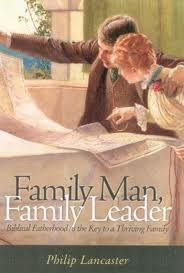
by Phillip Lancaster
Originally $14.00
March's price: $11.20
What this country needs is a few good men — husbands and fathers who are willing to love and lead their households with manly resolve and godly vision. Frankly, the Church needs these men every bit as much as the rest of the country. We are experiencing a national crisis of manhood of epidemic proportions. Absent a revival of fatherhood, we can expect to see an ever-increasing rise in the number of effeminate boys and masculine women, as well as the breakdown of the Christian family as it is defined in Holy Scripture. What we desperately need today are men who will be family men and family leaders. But how?
For more than ten years, Philip Lancaster has been instilling hope, and calling fathers to their rightful duties as family prophets, priests, protectors, and providers. He has emerged as one of the most articulate and theologically-sound defenders of the biblical family. Through his magazine Patriarch, Phil has reached thousands with both the vision and the tools necessary for family revival. Now, in his first book, Phil lays — in simple, easy-to-understand concepts — the biblical foundation necessary for men to turn their hearts to home and change the world. Family Man, Family Leader first presents the vision of biblical household leadership. Next, it addresses the many practical issues necessary for achieving victory as a man, from learning and acting upon God’s priorities, to decision-making as a father, to growing in oneness with your wife, to personal accountability before the Lord and victory over secret sins. Whether you are a veteran visionary father, or a dad just beginning the journey of patriarchy, we hope you find Family Man, Family Leader to be a source of inspiration and practical help.
Paperback. 329 pgs.
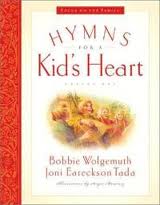
Hymn's for a Kid's Heart, vol. 1
by Bobbie Wolgemuth & Joni Eareckson Tada
Retail Price: $22.00
March's price: $17.60
Joni Earickson Tada and Bobbie Wolgemuth collaborate to help you teach twelve classic hymns to the children you love. With richly orchestrated music, true stories, prayers, and Scripture, "Hymns for a Kid's Heart" will feed your child's soul.
Format: Hardcover
Page Count: 96
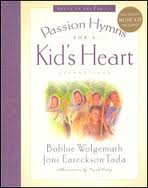
Passion Hymn's for a Kid's Heart
by Bobbie Wolgemuth & Joni Eareckson Tada
Retail Price: $22.00
March's price: $17.60
Authors Joni Eareckson Tada and Bobbie Wolgemuth are convinced that there is no better time to teach the power of the cross and the joy of the resurrection than the early years. What you hold in your hands has everything you need to teach children about the magnificent love of God and the power of the cross. Let the children you love understand the Passion of Jesus Christ and the warmth of God's love with beautiful music and heartwarming stories. Let them sing along with Joni, Bobbie, and the children on the enclosed richly orchestrated CD, and in no time they will have memorized these classic and treasured hymns.
This special Passion collection features twelve timeless hymns and is the fourth in a series by authors Joni Eareckson Tada and Bobbie Wolgemuth. It is filled with delightful stories from the Bible, devotionals, simple piano music, guitar chords, and beautiful original illustrations by Frank Ordaz.
If you want to focus your child's heart on the glorious truth of the crucifixion and resurrection of Jesus Christ, this book-with the enclosed CD-is what you're looking for. Could anything be a better gift?
Format: Hardcover
__________________________________________
Saturday, March 12, 2011
A great story about foster parenting...
Re-posted from: http://californiafostercarenews.blogspot.com/2007/02/foster-mother-attends-law-school-while.html
Foster mother attends law school, while nurturing the children in her care
On duty for kids, 24 hours a day
Vo, Kim. Mercury News, Feb. 12,2007.
With her 22-month old foster child never far from her, longtime child advocate Lois Rapp works in the office of Legal Advocates for Permanent Parenting (LAPP), where she serves as a senior lawyer for the non-profit organization.
After decades of caring for AIDS babies, shaken babies and traumatized teens, Lois Raap's husband encouraged the longtime foster mom to do something for herself. She wanted nights off -- to attend law school.
It almost didn't happen. The Los Gatos woman thought she could continue caring for only one foster child while studying. Then, the phone rang. Another child needed special care. Authorities suspected abuse. Could she help?
Raap reconsidered the dream. After all, at 49 it wasn't like she would launch a hot-shot legal career or ascend to the Supreme Court.
"What's really important here?'' she asked herself.
She thought hard -- and, in her take-charge way, decided to do both.
She laughs about it now, sitting in her dinky San Mateo office with its stacks of legal papers and a laundry basket of toys. Though it's a work day, Raap has brought in her latest charge, a toddler with spina bifida and an enormous grin.
"I'm an eternal optimist,'' she said.
Raap knew that going to law school would work out. She watched the kids in the daytime, made dinner, then left for class while her husband, Peter, took over. She read case law at Great America, sitting on amusement park benches while kids whooshed on roller coasters overhead. She wrote papers in various waiting rooms while she took her foster children to innumerable appointments.
By 2000, the year she was supposed to graduate from Northwestern California University School of Law, she had five foster children and a daughter getting married. So she extended her studies another year.
To Raap, it was nothing extraordinary. The daughter of a Calvinist pastor carries a sense of righteousness and duty. Many people have it bad in this world, she says, and those who don't should do what they can.
It's that attitude that helped Raap win a Ruth Massinga Award, administrated by the national advocacy group Casey Family Program. Raap recently won the award, which honors those who work with foster children, advocate to improve the child welfare system and "who can always be counted on to contribute.''
"She's an extraordinary person,'' said Regina Deihl, who works with Raap at Legal Advocates for Permanent Parenting. "She has for many, many years taken the children no one else would take, the children other people had given up on.''
According to Deihl, Raap sees the unique potential of each child and then declares, "We've got work to do here. Let's hop to it.''
Raap, now 60, wields her law degree like a sword. She helps write new legislation for foster parents, who she feels are not granted enough respect or rights. She takes on private clients, helping parents get services for special-education kids.
"I go ballistic. I know no one's speaking for those kids. I know I'm more expressive, more forthright than any of these kids.''
Her fierce advocacy has won her fans and probably detractors.
"Lois Raap is the high, high end of all the foster parents I've ever encountered,'' said former judge Len Edwards, who presided over Santa Clara County's Juvenile Dependency Court for 21 years before retiring last year.
Unlike many foster parents, he said, Raap regularly attended court hearings, even wrote her own detailed reports.
"She's an inspiration to all of us. When she'd come to court we'd all be on our toes because she'd ask -- demand -- extra care for the children,'' Edwards said. He acknowledged that some could interpret her demanding style as an ``irritant.''
That might explain why the Santa Clara County Social Services Agency initially declined comment when told that a county resident had won a national award. After nearly a week, the director of the Department of Family and Children's Services issued this wispy praise:
"The Raaps have been foster parents in the county for a number of years. The Department appreciates the efforts of all our resource families, and we are grateful for how much they give of themselves to care for our dependent children.''
Kids first
Raap shrugs it off. What matters, she says, is the kids, especially the ones who need extra care. The key for such children, she said, is to crawl into their mind, see how the world looks and jimmy the system accordingly.
And Raap, a former special education teacher, finds ingenious routes into a child's thinking. She remembered one brain-damaged child with a wry sense of humor. At sixth grade, he still couldn't read and eventually refused to pick up a book.
No books, she promised, and then copied "Amelia Bedelia'' onto flashcards. They read the cards, day after day. Eventually, she slipped him the actual book. To his astonishment, he could read it.
"I love challenges,'' she said. "I love the game.''
Law offers the same rush. So can Monopoly, but she tends to avoid it. "I don't play board games,'' she said, giggling, "because I'm way too mean.''
In it for long haul
Mean is not what comes to mind sitting in Raap's office, where the conversation stops every five minutes. The toddler in her care, a sprite with a big red bow, keeps tugging on Raap's arm. The girl wants food. Eggs. Now pears! In the chair. Out of the chair. Peek-a-boo!
Each time, Raap stops talking, answers and plays with the girl, then resumes the conversation. She never forgets where she left off.
This is her "bonus baby,'' a child she's delighted with and initially was surprised is still with her, months after birth. It seems no one wanted to adopt a sick baby. (The child's name is being withheld because she's in foster care.)
Raap knows this happens. She cared for HIV-positive babies when fear of the disease was so high that they were shunned at day care and churches. She's gotten calls on Thanksgiving, a house already full of kids, with the county needing to bring another by because no one would take her.
Then there was the Mercury News profile of her in 1996. She had hoped it would recruit sorely needed foster parents, but the first 10 calls were from animal lovers. Beagles were in one of the photos and people wanted to know where they could get the pups.
Once a child comes into her home, Raap's in for the long haul, until the child is adopted or reunited with biological parents.
Sometimes, the kids stay. Raap, who has two biological children and one adopted daughter, has had three children simply decide to live with her until they turned 18, and sometimes beyond.
"If you provide a home for a child and the kid decides your home is the forever home, you have no choice,'' she said. "You care for that child.''
Formula for success
Nathaniel Gray was such a child. His mother was suspected of having Munchausen by Proxy, a disorder in which people fabricate illnesses in their children to get attention. Gray showed up at age 13, and eventually said he wasn't leaving.
The Raaps "were encouraging independence, while being dependent on Jesus, which is cool,'' said Gray, now 22. Despite a seizure disorder, he's at college now; he won't say where so his biological mother can't find him. He still calls the Raaps regularly, and it's their home he returns to on Thanksgiving and Christmas.
The Raaps, he said, taught him to stand up for himself while helping others. That prompted him to intervene at his new school, where some disabled students were teasing the more severely disabled ones.
"So I tell them they don't have to like each other,'' he said, ``but they have to show respect.''
Raap doesn't know how many children she's cared for over the years. She measures her success on people like Gray, who arrived depressed, recovering from a surgery to help him walk and now cooks his own dinner, navigates buses and trains, and attends college.
And it's what she may do for this latest child. For Raap, it comes back to that essential question she asked herself when debating law school.
"What's really important here?''
Monday, March 7, 2011
My Father's Eyes
This song has been on my mind all this last week and I just wanted to share the lyrics with you...
I may not be every mother's dream for her little girl.
And my face may not grace the mind of everyone in the world.
But that's all right as long as I can have one wish I pray.
When people look inside my life, I want to hear them say.
CHORUS:
She's got her Father's eyes, her Father's eyes
Eyes that find the good in things, When good is not around.
Eyes that find the source of help, When help just can't be found.
Eyes full of compassion, seeing every pain.
Knowin' what you're going through, and feeling it the same.
Just like my Father's eyes, my Father's eyes, my Father's eyes
Just like my Father's eyes.
And on that day when we will pay for all the deeds we have done,
Good and bad they'll all be had to see by everyone
And when you're called to stand and tell just what you saw in me,
More than anything I know, I want your words to be
REPEAT CHORUS
Sunday, March 6, 2011
Daily Bible Reading: March 7 - 13
March 7th
Reading: Exodus 12:18-51
"And it came to pass, that at midnight the Lord smote all the firstborn in the land of Egypt, from the firstborn of Pharaoh that sat on his throne unto the firstborn of the captive that was in the dungeon; and all the firstborn of cattle"(vs. 29).
The day came and the Lord did just as He said He would. What an awful event as each family of Egypt lost their firstborn child. What a horrible consequence that the Egyptians had to suffer because of Pharaoh's unwillingness to grant the request of Moses. Yet, what a glorious story of God's power, purposes, and providence.
We see God's power in carrying out His plan just as He said He would. From the calling of Moses, through every plague, to the leaving of Egypt, we see God working His plan in every detail. We see God's purposes in separating Israel from Egypt, demonstrating His might for the people and future generations, and fulfilling His covenant promises to bring Israel out of Egypt again. And, we see God's providence as he provided a covering for the Israelites that they would not be touched by this act of death. Read verse 23 again.
"For the Lord will pass though to smite the Egyptians; and when he seeth the blood upon the lintel, and on the two side posts, the Lord will pass over the door, and will not suffer the destroyer to come in unto your house to smite you."
That act of the Lord passing over the doors with the blood covering is why this event and the meal of the lamb associated with it is called the Passover. Thank God that in His providence He has provided a way for all of us to be covered and protected from His judgment. That covering, as we will one day read in Scripture, is found in the blood of the Lamb of God, Jesus Christ.
March 8th
Reading: Exodus 13:1-22
In this chapter, the Lord states His claim upon the firstborn among both the animals and the children of men. This is an introduction to what the Lord requires as a demonstration that all is His. By claiming the firstborn as His, this becomes a symbol that the Lord owns all the cattle, all the animals, and all the people.
The Lord states to Moses in verse 2 that the children of Israel are to "sanctify" to the Lord all the firstborn males of animals and of men. The word "sanctify" means to make clean or pure. It also means to separate or set apart for a holy or special purpose. The firstborn male animals were to be offered to God as a sacrifice. If the animal was a donkey, an animal that the Israelites would not offer as a sacrifice, then a lamb would need to be offered in its place.
When something is offered in the place of another, like the lamb in the place of the donkey, this is what is meant by the word redeem. To redeem something means to purchase it back. This is what is said about the firstborn males in Israel, they will be redeemed. Read the last of verse 13 again, "…and all the firstborn of man among thy children shalt thou redeem."
The Lord laid claim of the firstborn male babies of the children of Israel as a symbol that He owns all the children. Each family then was required to offer a sacrifice, usually a lamb, for that child, redeeming the child. This sacrifice was an act by the parents in which they recognized that this child, like all the children given to them, really belonged to the Lord. The Lord owns all of creation including all people.
March 9th
Reading: Exodus 14:1-31
It must have been a great feeling of freedom when the children of Israel left Egypt. There was probably great rejoicing and celebration as they walked away. But, things soon turned to a time of fear as they found themselves pinned against the Red Sea with Pharaoh and his army in hot pursuit behind them.
Even though the Lord had miraculously delivered them from the land of Egypt, when the children of Israel saw the predicament that they were in with the Egyptians coming upon them, they fell into fear and complained to Moses. We will see that these Israelites will tend to swing in their emotions from trusting the Lord to completely doubting His abilities and ways. This is a picture of the heart of every man that can so easily lose heart when distressing times come. The children of Israel cried out to the Lord, which was the right thing to do. But, they quickly complained to Moses and spoke of their desire to be in Egypt. This, of course, was sinful to do.
The Lord takes care of His own, and is able to handle any situation. That is what Moses spoke to the people. His words are words that we need to keep close to our hearts. Read these words again, "Fear ye not, stand still, and see the salvation of the Lord" (vs. 13).
March 10th
Reading: Exodus 15:1-27
What a joyous occasion it must have been when Pharaoh and his army were destroyed in the waters of the Red Sea. We probably cannot even imagine how excited the children of Israel were to see their enemy, who had come so close to destroying them on the other side of the sea, now completely eliminated by the miraculous act of the Lord.
They were so excited that they created a song and sang it in celebration and remembrance of this act. There are great truths expressed in this song that we can take to heart ourselves. For example consider verse 2, "The Lord is my strength and song, and he is become my salvation: he is my God, and I will prepare him an habitation; my father’s God, and I will exalt him."
Israel, after their great deliverance, is ready to recognize God's might and the great salvation He has brought to them. In response Israel declares that they will exalt the Lord. This means that they will recognize and speak of how wonderful God is.
The deliverance of Israel from Egypt is a picture of the great salvation God provides for mankind from the enemies of sin and Satan. We, too, can sing a wonderful song of deliverance if we can say, like Israel did here, "The Lord is my strength…he has become my salvation: he is my God."
March 11th
Reading: Exodus 16:1-36
Early in our study of Scripture we were introduced to the sovereign nature of God. The One, True God is completely sovereign over all things. He controls all things and He can do all things. An outgrowth of God's sovereign nature, which is formed through His perfect love, is God’s providence. In this chapter we see an overt act of God's providence.
Can you imagine a huge number of birds, quail, flying into the camp each evening just waiting to be caught and eaten. Then, each morning, as the dew would melt away, the ground being covered with little, white seed like "things" that tasted like wafers made with honey. And there would be enough for every family every day. Not only that, but on the sixth day of the week, there would be enough that you could gather for two days.
They called the wafers that they gathered every morning, "Manna". The word Manna means "what is it?" The children of Israel had no idea what to call the food they were finding every morning, so they called it "what's this?" They did not know what it was, but it fed them day after day after day. In fact, we see by what it says in verse 35, that God provided them with this food for 40 years. Now, that's being a God of Providence.
March 12th
Reading: Exodus 17:1-16
The children of Israel complain again. This time it is because of a lack of water. We are going to have to get used to these people complaining, they seem to do it a lot. They complained for a lack of water at Marah, they complained for a lack of food in the wilderness, and now they are back to complaining about water.
In every tight and difficult situation God has provided for them. He separated the Red Sea and destroyed the Egyptians, He turned the bitter waters of Marah sweet, He is raining Manna down from heaven, and He will bring water from the rock of Horeb in this chapter. But, before God is able to provide, the people get really angry with Moses. They get so angry over the lack of water that Moses believes they are about to stone him.
We read these stories and probably think that these Israelites were quite a bunch of complainers and sure had short memories about what God had done for them. But, the reality of the situation is that we can be a lot like these Israelites. We complain about the rough times in our lives and we often forget far too soon what God has done for us. The children of Israel would far too quickly forget about the faithfulness of God. And, we do the same thing. Take time right now to thank God for all He provides for you. Make it a habit to thank God each day for all His provisions in your life, both big and small.
March 13th
Reading: Exodus 18:1-27
The news of God's deliverance of Israel from Egypt has traveled to Midian where Moses' father-in-law, Jethro, lives. Jethro, excited about the news he has heard, leaves to meet with Moses in the wilderness. He brings Moses' wife and two sons with him. From this reading we learn that Moses had sent them back to Jethro before he completed his trip to Egypt (see vs. 2).
I am sure that was a wonderful family reunion for Moses who had endured so much standing alone without other family members around him. Jethro is a great help for Moses, giving him suggestions as to how he governs the people. But, of even greater importance, is Jethro's acknowledgment that the Lord is "greater than all other gods."
Jethro, you may remember, was a priest in Midian. It is likely that he did not have a full understanding of who the One, True God was. In fact, he likely recognized and worshipped other gods. But, now having heard of what the Lord had done and listened to the testimony of Moses, Jethro turns his faith to the God of Israel.
You may not have a testimony of God literally separating the Red Sea for your escape from trouble. But, if you have faith in God, then you do have a testimony of God's love, care and protection. As God gives you opportunity, like Moses, you should share this with others, so they can learn to trust in God and rejoice in His salvation as well.
Saturday, March 5, 2011
Congratulations!
Congratulations to the Covenant Academy Rebuilders Varsity Boys Basketball team coached by David Barrett for taking 3rd place in the CSAA Tournament! It all came down to the last 20 seconds and my very own brother, Joel Barrett hit the game-winning shot...check it out!
http://www.bluelightspecialblog.blogspot.com/
http://www.bluelightspecialblog.blogspot.com/
Subscribe to:
Posts (Atom)